

Mechanical Criteria in Drone Design
Mechanical design is the most critical factor in determining the flight performance, durability, efficiency, and stability of drones. In this article, we will cover three main topics in drone mechanical design: frame structure, propulsion system (motor and propeller), and weight distribution & center of mass.
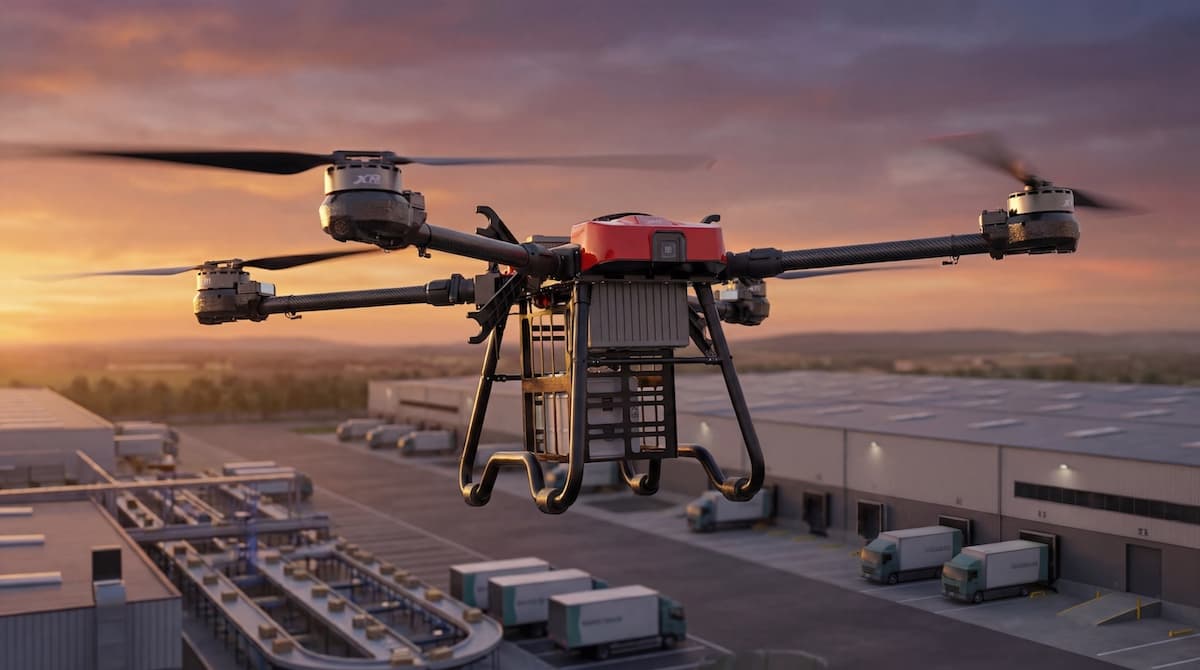
Mechanical Criteria in Drone Design
Mechanical design is the most critical factor in determining the flight performance, durability, efficiency, and stability of drones. In this article, we will cover three main topics in drone mechanical design: frame structure, propulsion system (motor and propeller), and weight distribution & center of mass.
Frame Structures
The drone frame is the primary load-bearing mechanical structure that carries the motors, control boards, battery, sensors, and other components. The main goal in frame design is to achieve maximum durability with minimum weight. Drone frames can have various geometries. The most common is the X-frame, which provides symmetric thrust, stable flight, and good maneuverability. The H-frame offers a wider platform and stable structure but is generally heavier than the X-frame. The Y-frame provides a simpler structure but is more difficult to control. Hexacopter and octocopter configurations use 6 or 8 motors, typically offering high payload capacity — however, they are less preferred due to increased cost and weight.
Frame Materials
Choosing the right material in drone frame design can make a significant difference in overall weight. The most commonly used materials are carbon fiber, aluminum, and plastic. Carbon fiber stands out for being very light, highly durable, and excellent at distributing vibration — but it is expensive and very difficult to repair when broken. Aluminum, despite adding weight, is frequently used across many drone components including the frame due to its durability, ease of machining, and low cost. Plastic, while reducing structural strength, makes the drone lighter and cheaper for high-volume production.
Arm Design
When selecting the arms on which motors will be mounted, key mechanical parameters include cross-section shape, arm length, and material choice. Cross-sections are typically round tubes, rectangular profiles, or carbon fiber plates. As arm length increases, stability improves and larger propellers can be used — however, maneuverability decreases and weight increases.
Landing Gear
The landing gear is the structure that supports the drone and protects it from damage during landing impacts. Key mechanical design criteria include sufficient ground clearance, light weight, and shock absorption. Common materials include carbon fiber, plastic, and aluminum.
Propulsion System (Motor and Propeller)
The propulsion system is the mechanical system that enables a rotary-wing UAV to take off, stay airborne, and maneuver. It consists of motors, propellers, and Electronic Speed Controllers (ESC).
Brushless DC motors (BLDC) are most commonly used in drones. Their advantages over other motors include high efficiency, high RPM, low maintenance, long lifespan, and low friction — which is why nearly all modern drones use BLDC motors.
Propellers are the components that directly generate lift. They can have 2 or 3 blades. 2-blade propellers are more efficient and provide longer flight times, while 3-blade propellers offer more thrust and better control. Plastic propellers are cheap and light but break easily; carbon fiber propellers are expensive but very strong, rigid, and high-performance. Motor-propeller compatibility is critical — poor choices lead to reduced efficiency, motor burnout, and ESC damage. In a 4-motor configuration, 2 propellers spin clockwise and 2 counter-clockwise, ensuring torque balance and stable flight.
The ESC is the electronic component that controls the speed of BLDC motors. It regulates motor speed, transfers battery energy to motors, and receives commands from the flight controller.
For a drone to take off, thrust must exceed its weight. The general design rule is: Total Thrust ≥ 2 × Drone Weight — though this may vary by manufacturer. A good propulsion system produces high thrust with low energy consumption and minimal vibration.
Weight Distribution and Center of Mass
Weight distribution and center of mass are critical criteria in drone design from the perspective of flight stability and control performance. Poor design can cause vibration, unstable flight, and control difficulties. For stable flight, the center of mass must be close to the geometric center of the frame and aligned with the center of thrust produced by the motors. The flight control system assumes the drone is balanced at its center point — if the center of mass shifts, motors must produce different power levels, energy consumption increases, and the control algorithm is strained.
The main heavy components on a drone include the battery, camera or sensors, flight control board, ESC, and GPS module. The battery is typically placed at the center of the drone as it is one of the heaviest parts. Cameras and sensors are mounted at the front or top. BLDC motors are placed on the arms. Ideally, the center of mass should be close to the plane of the propellers — if too high, the tipping moment increases; if too low, maneuverability slows. Symmetry is very important in drone design: symmetric configurations simplify control algorithms, reduce vibration, and balance motor loads — which is why the X-frame is the most preferred configuration.